Chris Walsh Center
For Educators And Families
AT FRAMINGHAM STATE UNIVERSITY

Upcoming Events
Coaching Neurodivergent Children and teens to Success

Hi,
We have openings for parents/caregivers and siblings to attend the Sibling Support Program: A Family-Centered Mental Health Initiative on Thursday, May 7, 2026! This free program focuses on building sibling resiliency, decreasing trauma and strengthening families of youth with Autism Spectrum Disorder, Developmental Disabilities and/or Mental Health Issues.
Please share the attached flyer with relevant clinicians, families and on social media platforms.
https://shriver.umassmed.edu/siteassets/uploads/2023/12/ssp-flyer-current.pdf
Check out the FAQs about this program below.
This program is available year-round on the first Thursday of each month.
FAQs
Who is eligible to participate?
-
Parents & caregivers, regardless of the age of the children. This includes all adults in a caregiving role, such as grandparents, aunts and uncles.
-
Siblings between the ages of 6 –18 that are able to engage appropriately and independently in a group setting.
-
The child with challenging behaviors is not eligible to participate; this program is designed to support the family members of that child.
-
Parents/caregivers can participate if siblings do not, and vice versa.
What is the program about?
For Siblings it is an opportunity to meet peers that understand what it’s like to have a brother/sister with behavioral issues, express their feelings and process their experiences in a safe setting, and learn coping strategies.
Parents & caregivers join an information session on how to decrease trauma and increase resiliency among siblings. We discuss the experience of siblings, strategies for parents/caregivers to best support siblings, information on why it is important to support siblings, and resources for the family. Once parents/caregivers have attended the first session, they are invited to join a follow-up discussion group offered on subsequent Thursdays.
Can parents/caregivers join the sibling group? Can siblings join the parent/caregiver group?
The short answer is no. Siblings and parents/caregivers meet separately. We have created a safe space for siblings where they can speak freely and don’t need to worry about censoring themselves because parents/caregivers are listening. And the same is true for parents/caregivers—they also benefit from a private Zoom group where they don’t feel inhibited when speaking or worry they might say something that the sibling could misinterpret.
Are siblings grouped by age?
Yes, we place siblings in age-appropriate groups. Young siblings are grouped together and teen siblings have their own group.
How do I encourage siblings to participate in the sibling group?
-
Avoid using the phrase “support group” because that can feel intimidating.
-
Instead, explain that we understand how growing up with a brother/sister with behavioral issues impacts the whole family. Our job is to make sure that family members are doing okay, so we ask all caregivers and siblings to participate.
-
Siblings can attend just one time to see what it’s like.
-
Siblings do not have to share information unless they want to. It’s okay to just listen.
-
Other siblings have been ambivalent about attending the group and afterwards said they were very glad they participated.
Can siblings participate if they have behavioral challenges themselves?
Our sibling group is for siblings to have a safe place where they are not faced with behavioral issues from other children. So, if the sibling isn’t able to listen to others, take turns talking, participate appropriately in conversations, or sit for the hour-long group, the answer is no. In those cases, it won’t be a positive experience for that sibling or others in the group.
Where is the program held?
This is a remote, online program offered on Zoom. Parents/caregivers can be together or not on one device. If there are multiple siblings in the family, we encourage them to be on separate devices if possible.
Is there a fee to participate?
This is a free program.
When does the program take place?
The first Thursday of each month. The sibling group is 5:30pm – 6:30pm EST, the parent/caregiver group is 5:30pm – 7pm EST, and the follow-up parent/caregiver discussion group is 5:30pm – 6:30pm EST.
Do I have to commit to participating every month?
Parents/caregivers and siblings can participate one time or as often as you like. Families must sign up each month they want to participate, since there is a limited number of spots.
Do I have to complete the survey after participating in the group?
Please do! Participant names are not included on the surveys, so your feedback is confidential.
Our program is grant-funded and we present survey data to our funders. Also, we rely on the survey responses to learn how to improve our program and support more families like yours.
How do I sign up?
Contact us at the address below and we will email consents for all participating individuals. Once we receive the completed consents, we will confirm participation the week of the program, then email the log-in link, resources, and a link to a survey to be completed after the group is over.
What if I have more questions?
Email or call us! Emily.rubin@umassmed.edu or 857-523-1145 (cell)
--
Leah Baigell, MA
Parent Mentor
UMass Chan Medical School l Eunice Kennedy Shriver Center
C: 781-698-9118 l E: leah.baigell@umassmed.edu
Emily Rubin, MA, LICSW
Director of Sibling Support
Assistant Professor in Psychiatry
UMass Chan Medical School l Eunice Kennedy Shriver Center
P: 857-523-1145 l E: Emily.rubin@umassmed.edu
Coaching Neurodivergent Children and teens to Success
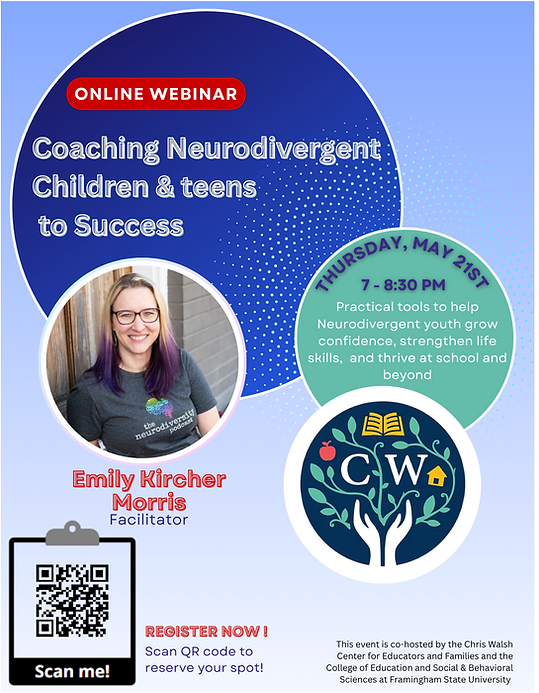
Emily Kircher Morris
Raising and educating neurodivergent young people often feels like coaching a team without a playbook: Every day brings new challenges, unexpected wins, and moments that test your patience and your heart. In this encouraging and practical presentation, Emily shares a framework to help support the development of five essential skills that neurodivergent kids need to navigate both school and life: self-advocacy, emotional regulation, executive functioning, communication, and motivation. With insights drawn from neuroscience, real-life stories, and her work with neurodivergent, gifted, and twice-exceptional learners, Emily helps families shift from crisis mode to connection, offering tools that grow confidence, not just in kids, but in the adults who support them.
Who is Emily Kircher Morris?
We are honored to welcome Emily Kircher-Morris, LPC, a nationally recognized speaker and a highly respected voice within the neurodivergent community. Emily is widely known for her work in advancing neurodiversity-affirming practices and for supporting educators, families, and clinicians in better understanding and serving neurodivergent individuals.
May 21st 7-8:30